
 By
By Artificial intelligence has been marketed as the technology that will abolish scarcity, reinvent work and possibly answer emails without beginning ‘Hope this finds you well.’ The bond market has discovered one stubborn limitation: money still charges interest.
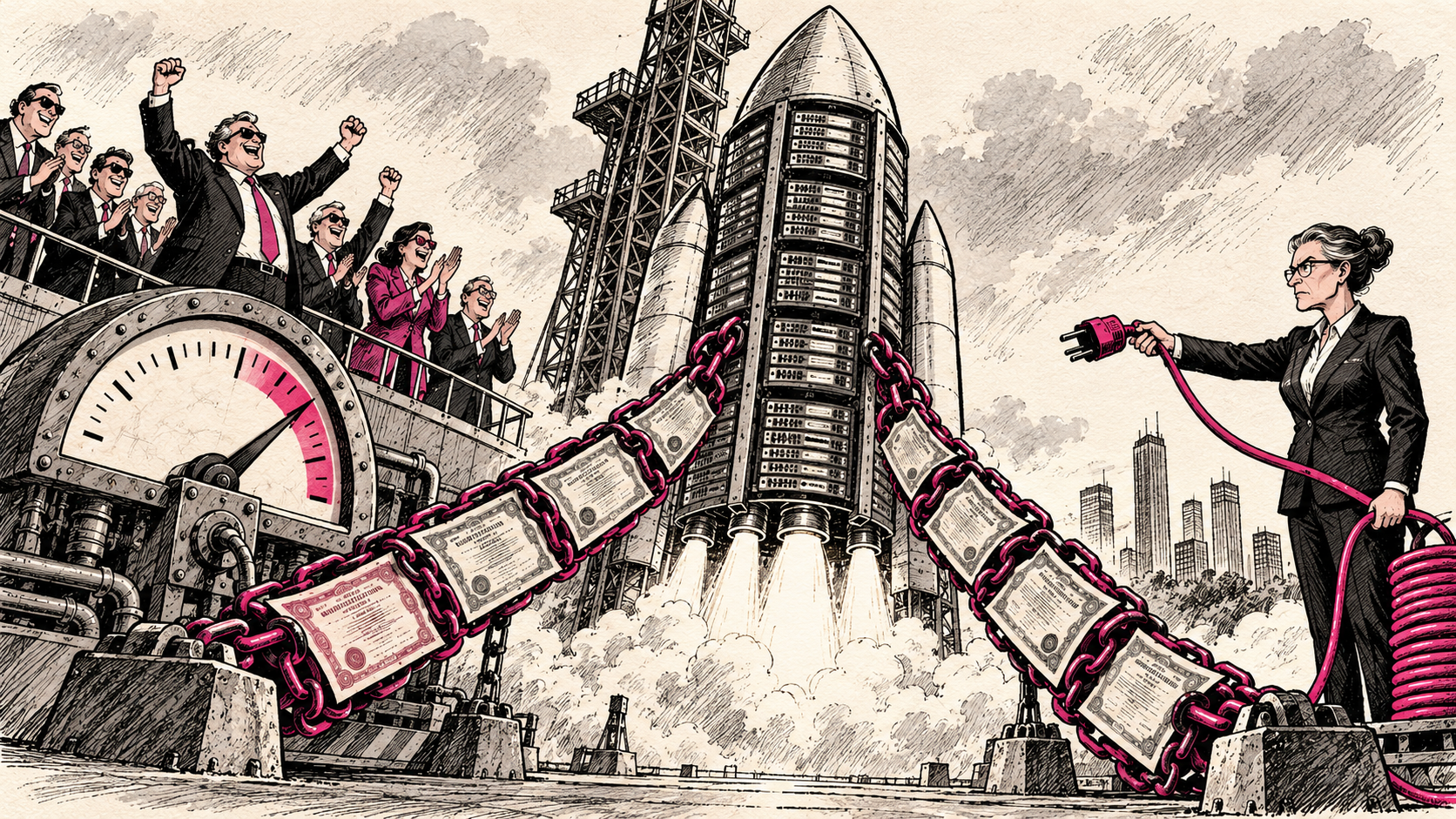
CoreWeave, the Nvidia-backed cloud company that rents computing power to AI developers, became the week’s most expensive demonstration. Reuters reported that the company’s April bonds were yielding around 15% Thursday, above levels typically associated with financial distress. The cost of insuring its debt against default surged past 1,000 basis points, while shares had fallen sharply. In ordinary English, lenders have begun pricing the unlimited future like a car loan offered beside a handwritten sign.
The company is not a vaporware startup operating from a folding table. It reported a large revenue backlog and enormous demand for computing capacity. Its SEC filings also show how aggressively it financed that growth: billions in term loans and senior notes, followed in September by an upsized $4.2 billion convertible-note offering. Reuters put total obligations near $50 billion, a figure that includes more than conventional bond debt. CoreWeave says its business is sound and its financial position is improving.
Both statements can coexist. A company can have customers, revenue and a real product while also discovering that a capital-intensive expansion becomes less charming when borrowing costs rise. Data centers require chips, land, power, cooling systems and enough cables to knit a sweater for Delaware. The sales pitch arrives as software. The invoice arrives as heavy industry.
Earnings Call From The Future — Parody
Analyst: When does artificial general intelligence arrive?
Management: Before the next refinancing, ideally.
Analyst: And the path to profitability?
Management: Please refer to slide 47, ‘Exponential.’
The market’s concern extends beyond one company. AI-related firms led stock declines as investors reconsidered whether future revenue can justify the sector’s current spending and leverage. Reuters reported that U.S. technology giants are expected to spend more than $700 billion this year on the buildout. A boom funded from cash is one kind of bet. A boom funded by debt at rising rates is the same bet wearing a countdown clock.
CoreWeave’s concentration adds another layer. Its business depends heavily on a small number of giant technology customers, while Nvidia is both a major supplier and a significant investor. That ecosystem can look like unstoppable demand when everyone is expanding. It can also resemble a very sophisticated group chat in which the same dollars keep replying to one another.
None of this proves CoreWeave will default, or that the AI investment cycle is collapsing. Credit markets overshoot. Bond prices move for reasons that include inflation, Federal Reserve expectations and the broader flight from risk. Nvidia chief Jensen Huang said CoreWeave’s financial strength improves daily and rejected the idea that Nvidia needs to backstop it. Those are material facts, not footnotes to hide behind the joke.
But the stress punctures a convenient story. AI boosters often describe infrastructure spending as the inevitable down payment on a transformed economy. ‘Inevitable’ is a lovely word in a keynote because it has no coupon payment. In a debt prospectus, inevitability must report to cash flow twice a year.
The public stakes are larger than one ticker. Utilities are planning generation around data-center demand. Communities are offering land and incentives. Investors’ retirement funds can be exposed through stock and bond holdings. If the race slows, companies will not refund the power plants, transmission lines or tax breaks with a handwritten apology from the future.
For now, the AI boom remains enormous, real and capable of producing both useful technology and remarkable revenue. It is also built on financial structures that do not become futuristic merely because the collateral has GPUs. The machines may learn. The debt still remembers every payment date.