
 By
By Please join the board in congratulating Texas grassroots politics on its most successful funding round. The product now supports television saturation, turnout operations and one extremely large root named Elon.
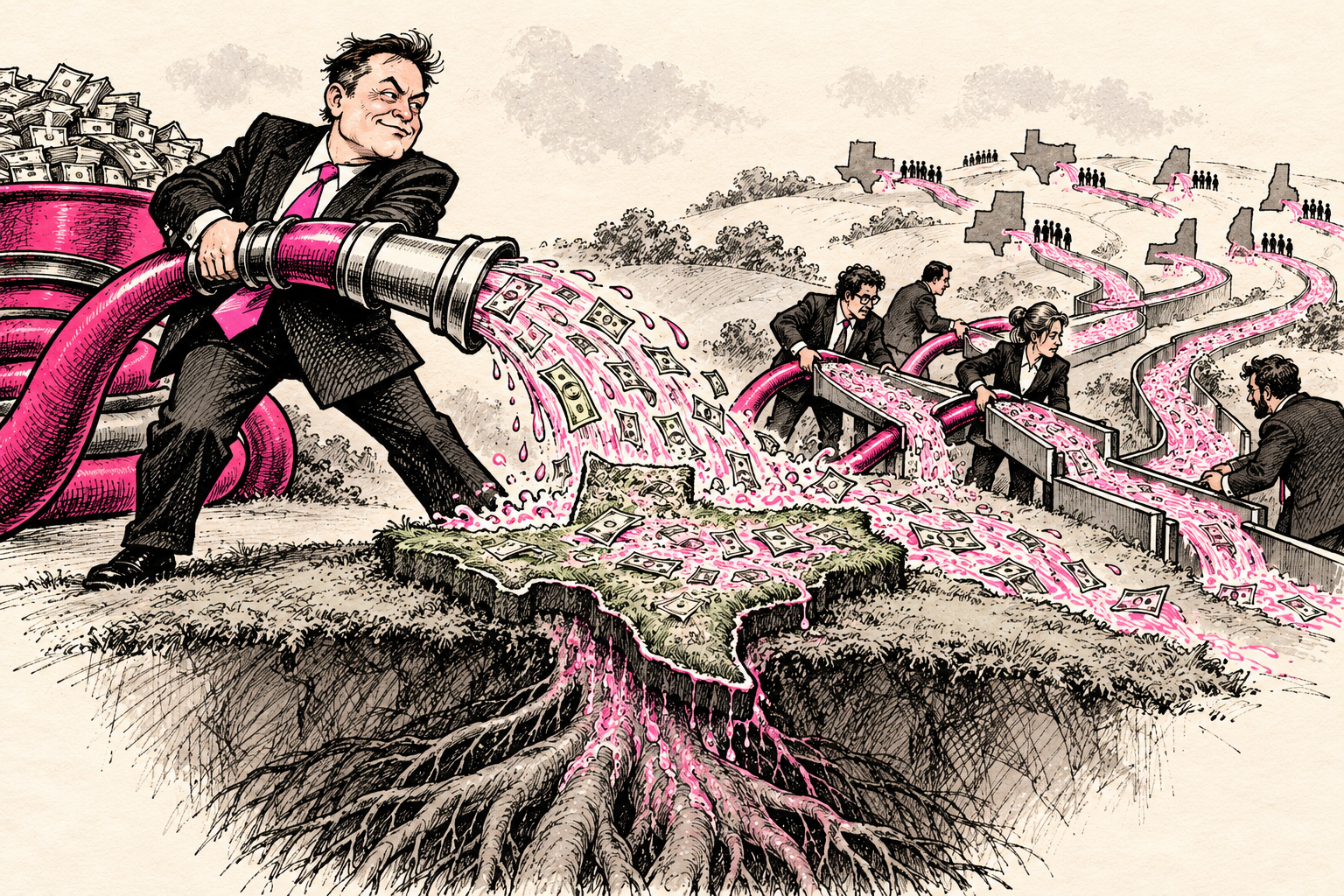
Federal filings disclosed October 15 show Musk gave $158 million in September to the Senate Leadership Fund, the main Republican super PAC supporting Senate candidates. Axios reports that the money helped finance a rescue plan for Republican Ken Paxton's Texas campaign after internal polling alarmed Musk's team and Senate Republicans. The Texas Tribune reports two donations—$75 million on September 9 and $83 million on September 23—followed by matching transfers into a new Texas PAC.
The figures are not a claim that every dollar went directly from Musk to a Paxton advertisement. Money moves through several committees and supports races beyond Texas. But the sequence and filings show something more revealing than a single ad buy: Musk's money let national Republicans defend Paxton without draining funds from other battlegrounds.
This is the political equivalent of a billionaire paying the emergency room bill so the party can keep its wellness budget. Democracy remains priceless, but apparently stabilization capital comes in nine figures.
A Very Organic Capital Structure
Axios says Musk's political team first proposed a $5 million matching arrangement for a pro-Paxton group. Negotiators improved the offer into a $20 million package: $10 million from Musk if the Senate Leadership Fund supplied $5 million and the outside group raised another $5 million. Within days, Republicans had mobilized the money for television.
Then came the larger checks. Musk accounted for nearly 58 percent of the $273 million the Senate Leadership Fund raised during the third quarter, Axios reports. The Texas Tribune says groups led by the fund spent more than $217 million on Texas Senate advertising by the end of September, while Musk's America PAC put $18.8 million into the race through October 13, mostly against Democrat James Talarico.
Paxton is still running for office, not being acquired. Voters retain the right to ignore every ad. Talarico also raised an extraordinary $64 million in the third quarter, according to AP, so this is not a fable about one wealthy man single-handedly buying a completed election result. It is a story about one wealthy man changing the national allocation of political resources before voters decide.
That distinction should sharpen the concern, not dissolve it. A donor does not need to purchase a candidate like a subsidiary to wield enormous power. He can make an expensive rescue feasible, free the party's money for other states and ensure that his preferred political network reaches voters at industrial scale.
The Market Has Spoken; It Has One Shareholder
Republicans describe the spending as necessary to defend a seat Democrats made competitive. Of course they do. Political committees exist to win elections, and the law permits super PACs to raise unlimited sums while barring coordination with candidates. The relevant filings give the public more information than a brown envelope ever did.
Disclosure is not the same as democratic balance. Reading that one person supplied $158 million is useful in the way a fire alarm is useful: it tells you exactly why the room feels unusual.
The liberal answer cannot be pretending Democratic money arrives by woodland creature. Big donors and outside groups spend across the political spectrum. Talarico's record fundraising proves small-dollar language can coexist with a campaign treasury large enough to require its own weather system. The standard should be structural: no citizen's political reach ought to scale this violently with personal wealth.
Public financing, stronger transparency and rules limiting the power of outside money are less glamorous than another billionaire entrance. They also offer a system in which a party has to build support rather than wait for a lead investor to close the round.
Musk's investment may help Paxton win or it may not. The immediate return is already visible: Republicans can spend elsewhere because one man made Texas less expensive for them.
That is not grassroots. It is private equity with yard signs, and the limited partners are the rest of us.