
 By
By Canada's industrial policy has reached the portion of the free-market seminar where the government points to the contract and the American owner points to the weather. In this case, the weather is made of tariffs and up to 500 Ontario jobs are standing outside without coats.
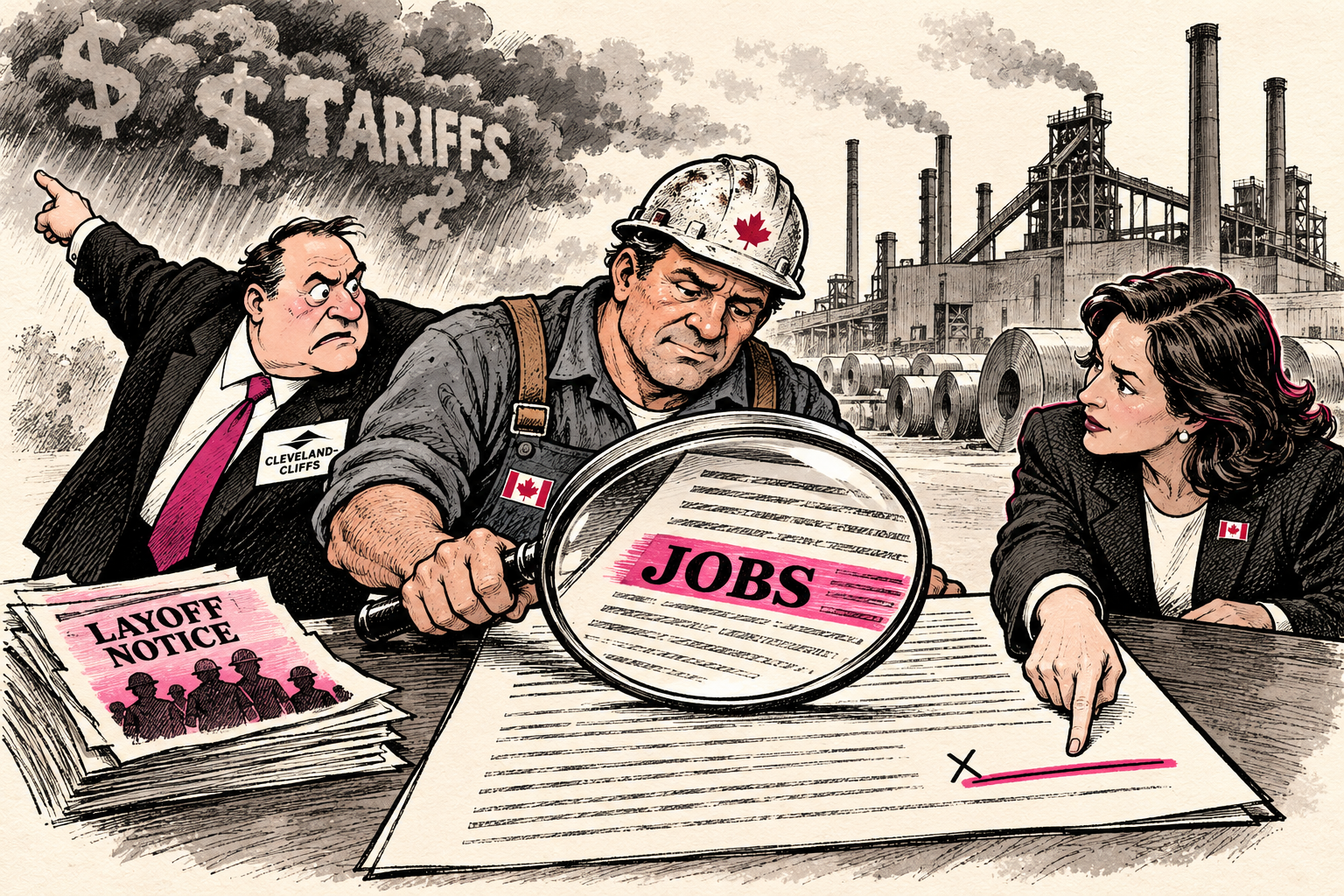
Cleveland-Cliffs bought Stelco in 2024 after giving Ottawa legally binding undertakings tied to the acquisition. The Canadian government said at the time that the commitments included maintaining employment and operating the business in Canada. Last month, the U.S. owner announced it would idle finishing operations in Hamilton and concentrate steel production at Nanticoke, blaming a market upended by U.S. steel tariffs of as much as 50 percent. Reuters reported that up to 500 workers could be affected.
On October 15, Industry Minister Mélanie Joly said negotiations remained possible but that Canada could seek penalties, enforcement of the commitments or a court-ordered sale of Canadian assets. Global News reports that the first layoffs have begun and that the rest are expected over several weeks. Stelco's president says the government's claim that the layoffs breach its undertakings is false and argues the tariff shock created a different economic order from the one the company expected.
No court has ruled that Cleveland-Cliffs violated the deal. No forced sale has been ordered. The current dispute is a government threat, a corporate denial and a large group of workers discovering that the phrase material change in circumstances can sound remarkably like a locker being emptied.
Who Gets The Bill?
The company's case is not nonsense. A 50 percent tariff imposed by the United States on Canadian steel is not a rounding error. It can reorder export economics faster than a board can say long-term commitment. Governments that create trade shocks should not act surprised when factories show up in the impact statement.
But market difficulty does not erase promises used to secure approval for a foreign takeover. Canada's official 2024 statement said the undertakings helped establish that the acquisition would likely be of net benefit to Canada. That is the bargain: access to the asset in exchange for enforceable public-interest commitments. Net benefit cannot mean benefits are binding while conditions are favorable and optional when ownership becomes inconvenient.
Under section 40 of the Investment Canada Act, a court can order compliance, impose financial penalties or direct divestiture when a non-Canadian fails to meet a demand under the law. The government does not get to seize a steel mill by announcing that everything is on the table at a microphone. It has to use the statutory process and prove its case.
That procedural friction is a feature. Forced sale is a serious remedy, not an applause line. Ottawa should publish as much of the commitments and its reasoning as confidentiality rules allow, identify the alleged breach precisely and explain what outcome would actually preserve production and employment. A different owner with the same market problem is not an employment plan wearing a fresh lanyard.
The Warranty Department Is International
The comic contradiction is that everyone suddenly wants government to behave like a stern contract manager after years of selling foreign investment as self-executing prosperity. The sale received a ceremonial ribbon. The enforcement phase gets lawyers, deadlines and several hundred people asking whether a promise is a benefit or a coupon.
Workers did not set the American tariff, negotiate the takeover or draft the undertakings. Yet they are the first group asked to absorb the disagreement. Cleveland-Cliffs says market conditions changed. Ottawa says the commitments remain. The employee receives a notice proving both parties have excellent stationery.
A fair resolution has to confront the trade shock while refusing to make labor the automatic shock absorber. That may mean enforcing the deal, negotiating revised operations with real job protections, or finding a buyer capable of operating the assets. It should not mean quietly converting a public promise into a severance calculation.
There is nothing anti-business about expecting a buyer to honor conditions attached to a purchase. There is also nothing pro-worker about threatening the maximum remedy without showing how it keeps a mill viable. Power deserves a ledger on both sides: what the company promised, what the government changed, what each proposes now and who pays during the argument.
The free market has finally reached the terms and conditions. Funny how the fine print becomes legible when 500 jobs are holding the magnifying glass.