
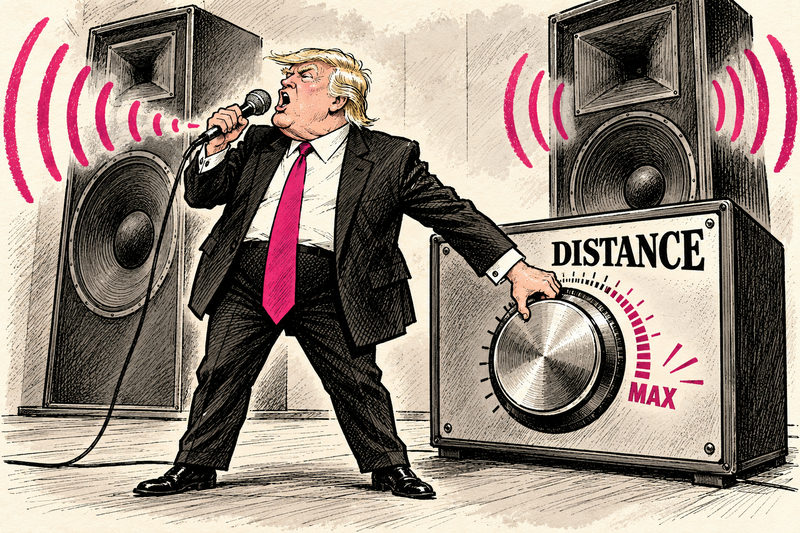
Presidential distance is measured in decibels. The farther Donald Trump says he is from something, the more important it becomes that the back row hear about it. This is the rare hands-off position that could use a sound engineer.
AP reports that Ilhan Omar’s lawyers are demanding the return of seized property and preservation of search recordings. They allege an unlawful, politically motivated investigation; DOJ disputes their allegations and says it followed court orders and legal obligations. The search was approved by a magistrate judge.
The same report describes Trump publicly suggesting, before the search, that Vance and his people were investigating Omar, then saying afterward that he had “nothing to do” with it. That does not establish that Trump ordered the search. It does establish a presidential claim of distance with excellent projection.
The Uninvolvement Sound Check
Imagine, as parody, an audio technician preparing the president’s declaration of remoteness. A small microphone will not do. People at the far end of the room might fail to appreciate just how little he has to do with the subject he brought up. Bring the larger speakers. Independence deserves bass.
The technician tests the left channel: an opponent is under investigation. The right channel: the president has nothing to do with it. Played together, they produce the distinctive stereo effect of political benefit arriving from one direction while responsibility walks briskly out the other.
Our fictional technician asks whether the president would prefer to stop talking about the investigation. An amateur question. Silence would leave the audience with no way to admire the distance.
There is a perfectly straightforward way to avoid turning an investigation into political entertainment: do not perform it for a political audience. Unfortunately, that approach lacks the magnificent self-restraint of repeatedly announcing how removed you are.
No one has to invent a secret presidential instruction to criticize this rhetoric. The public statements are already doing plenty of work. A microphone need not control an investigation to help turn it into a spectacle.
The Record Is Not The Applause
The new legal demands also introduce an awkward rival to the sound system: a record that can be examined. The lawyers’ allegations and DOJ’s rebuttal remain competing positions, not findings supplied by this article. Whatever a preserved recording shows would have to be assessed on its contents, not on whether either side has the more satisfying slogan.
Our imagined technician finds this deeply inconvenient. A recording retains the quiet parts. It can be paused. It does not automatically swell when the speaker reaches the name of a disliked opponent. From a rally-production standpoint, evidence has very poor audience instincts.
The temptation is to treat a loud denial as if it answered every quieter question. But volume is not a diagram of who decided what. Nor is a presidential insult proof of the orders that investigators received. We need the actual record for that, not a more expensive subwoofer.
Back at the fictional sound check, everything is ready. The declaration of distance reaches the rear wall. The claim of uninvolvement has exceptional clarity. The president can remain completely removed from the matter without anybody missing the announcement.
Please respect the president’s distance. You can hear it from here.