
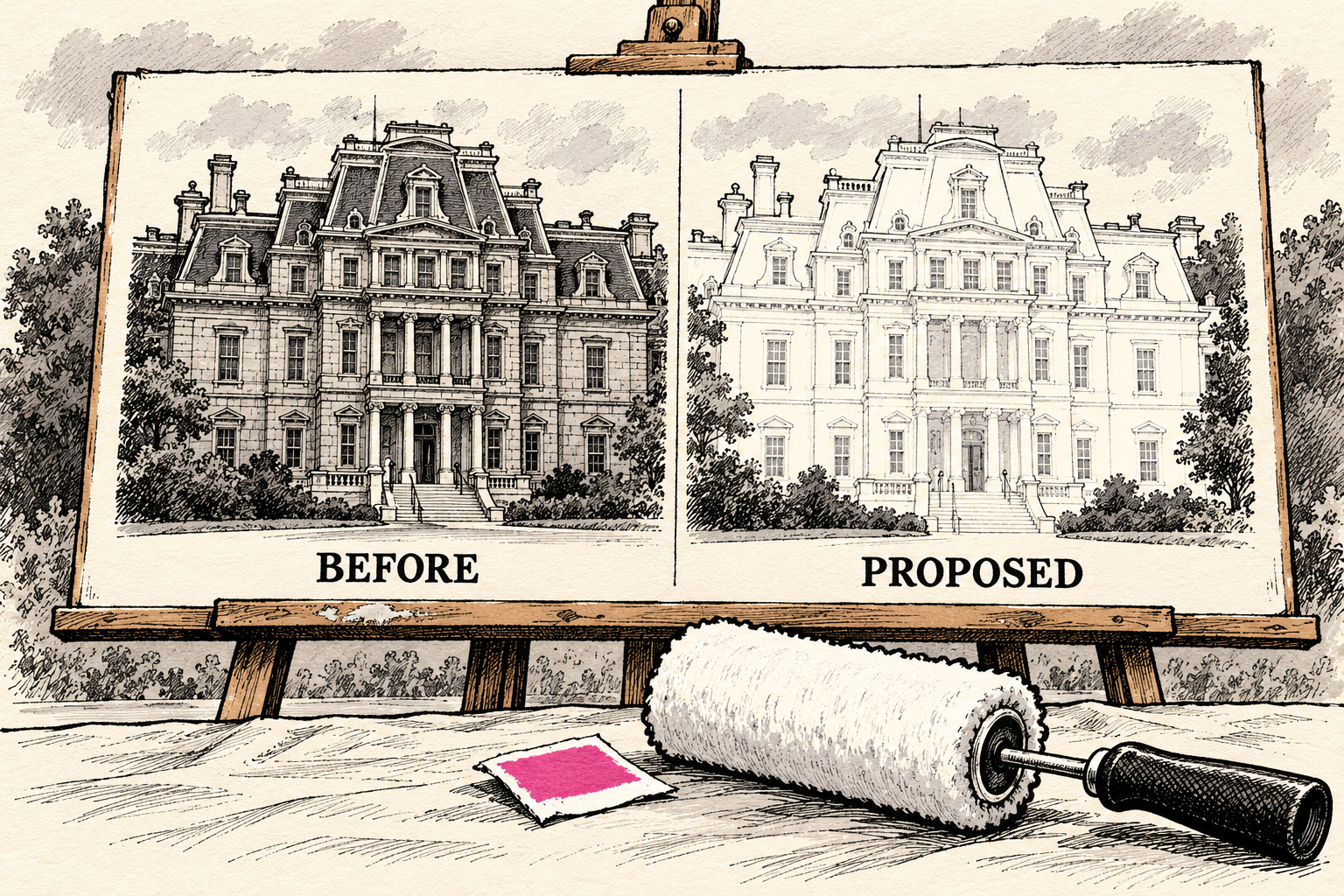
The Eisenhower Executive Office Building is being considered for an exciting upgrade: continued existence, with fewer distinguishing characteristics. The administration’s own assessment has identified the historic character as the part most likely to get in the way of the improvement.
According to AP, a draft assessment published Friday says Trump’s proposed white paint would diminish the White House complex’s historic character. The building is gray. The president dislikes the gray. Unfortunately, the gray has brought references.
This is an awkward personnel dispute between an aesthetic preference and a nineteenth-century landmark. The preference has presidential backing. The landmark has the disadvantage of having looked like itself before the current administration began evaluating appearances. Its architect’s choice of materials is suddenly behaving like an unauthorized design decision.
Ordinarily, a historic building gets some credit for retaining the qualities that make it historic. Under this approach, those qualities may remain on the premises, but they should stop drawing attention to themselves. We are keeping the landmark. We are simply asking it to dress as a different landmark for work.
The Character Is The Complication
There is an important distinction in the assessment: it does not establish that the proposed paint would ruin the stone. It finds the proposed mineral paint unlikely to trap moisture, with more testing needed on removal. The structure might therefore emerge from its transformation perfectly capable of standing there, wondering where its personality went.
That distinction deprives the project of a tidy argument about whether paint is physically catastrophic. The more revealing question survives: why is preserving a building’s appearance considered an obstacle to making it look better? Apparently, the historic part has been interpreting its job description too literally.
A palace of presidential taste need not demolish history. It can retain history’s volume, windows and inconvenient weight while requesting a more supportive finish. The past will still be present. It will just have learned not to contradict the color scheme.
The assessment also describes a relationship among the buildings: the white building at the center draws importance from the contrasting stone buildings around it. This is a surprisingly vulnerable arrangement for architecture. A neighbor that helps make the White House distinctive can apparently be faulted for not looking enough like the White House.
Imagine, as an architectural parody, a choir director who finds the harmony distracting and asks every singer to perform the solo. Uniformity has been achieved. The reason anyone assembled the choir has become harder to identify.
There is even a less transformative alternative: cleaning, restoration and improved lighting. That would let the building look more like itself. An admirable technical solution, although it offers the president the limited satisfaction of discovering that someone else’s design was already there.
The proposal remains a proposal. Nobody needs to pretend the paint has already gone on, or that the stone has already suffered, to appreciate the executive ambition. A public landmark has been given an opportunity to participate in its own improvement by becoming less recognizably the thing being improved.
The building may remain historic, provided it stops looking as though anything happened before Trump arrived.